Cash Flow Control
Control, diversify, increase inflows, outsmart outflows. Most families react to cash flow. The ones who build lasting wealth architect it — deciding where every dollar enters, sits, moves, and works before it arrives.

The Book
A Framework for Protecting Assets, Preserving Capital, and Passing It Forward
Your family's wealth is being eroded from seven directions simultaneously. Not by bad advice. By uncoordinated advice. This book reveals the architecture that replaces fragmentation with a single, integrated system.
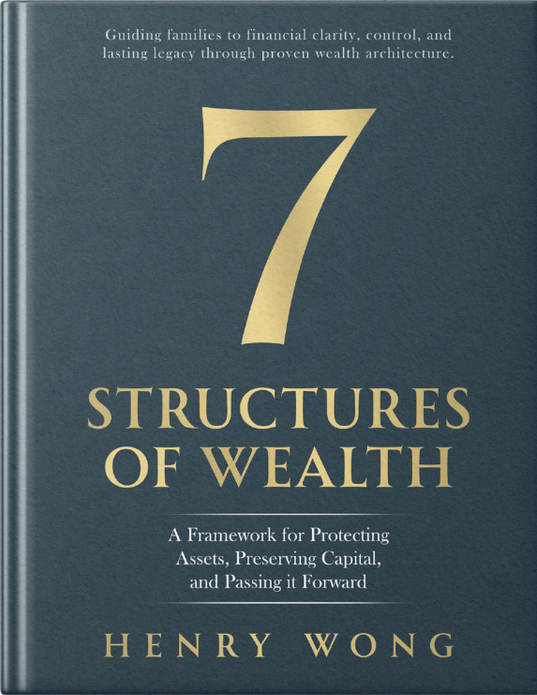
Your accountant has never sat in a room with your insurance advisor, your investment manager, and your lawyer. Each one is competent in their domain. None of them is responsible for the gaps between domains. That's where wealth erodes — not through incompetence, but through coordination failure . The 7 Structures framework makes the invisible visible.
The Framework
Wealth erodes across seven dimensions. Most families are exposed in at least three. When all seven structures are integrated, they stop working independently and start reinforcing each other. That's the difference between a collection of strategies and a unified system.
Who This Is For
You've built something real. Your enterprise generates. Your family is growing.
But you carry a quiet weight — the sense that your wealth isn't as coordinated as what you've built deserves. Your advisors each see their own piece. Nobody sees yours.
That weight has a name. It's called fragmentation. And this book was written to replace it with architecture.
Entrepreneurs and owner-operators whose corporate complexity has outgrown the advisors who served them at the start. Your retained earnings sit in one entity, your risk sits in another, and nobody has drawn the map that connects them. The cost of that gap compounds quietly, every year.
Physicians, dentists, lawyers, and engineers operating through professional corporations. You built the practice, but the wealth it produces was never structured to work as hard as you did to earn it. Left fragmented, it leaks through tax, timing, and containers it was never designed for.
Whether in real estate, holding corporations, or layered entities, your wealth demands coordination no single advisor provides. Concentration without architecture is not strength. It is one point of failure wearing the costume of success.
You are building beyond your own lifetime. But values, governance, and wealth transfer do not harmonize by intention alone. Without one unified structure, the next generation inherits your assets and your fragmentation together.

Start Here
If you've read this far, you already sense the gap. The Wealth Structure Diagnostic measures it. Fourteen questions. Seven structures. The clarity to know exactly where your wealth is exposed — and where to build next.
Take the Wealth Structure Diagnostic →
Time is not on your side. Every year fragmentation goes unnamed, the cost compounds quietly. Fourteen questions is the fastest way to find out where.